Across many African communities, conversations about peace are still framed too narrowly. Governments discuss security deployments. International organizations focus on emergency interventions. Communities themselves are often left navigating the aftermath of instability with limited institutional support and fragile social systems.
Yet the deeper reality is more complicated.
Peace is rarely sustained by force alone. A community does not become stable simply because violence temporarily declines. Stability begins to take root when people can access healthcare without traveling impossible distances, when young people can imagine economic futures within their own communities, when local institutions function with credibility, and when development projects are designed to outlive political cycles.
In many parts of Africa, especially in regions that have experienced prolonged social or economic strain, peace and development are not separate conversations. They are deeply interconnected systems that shape one another every day.
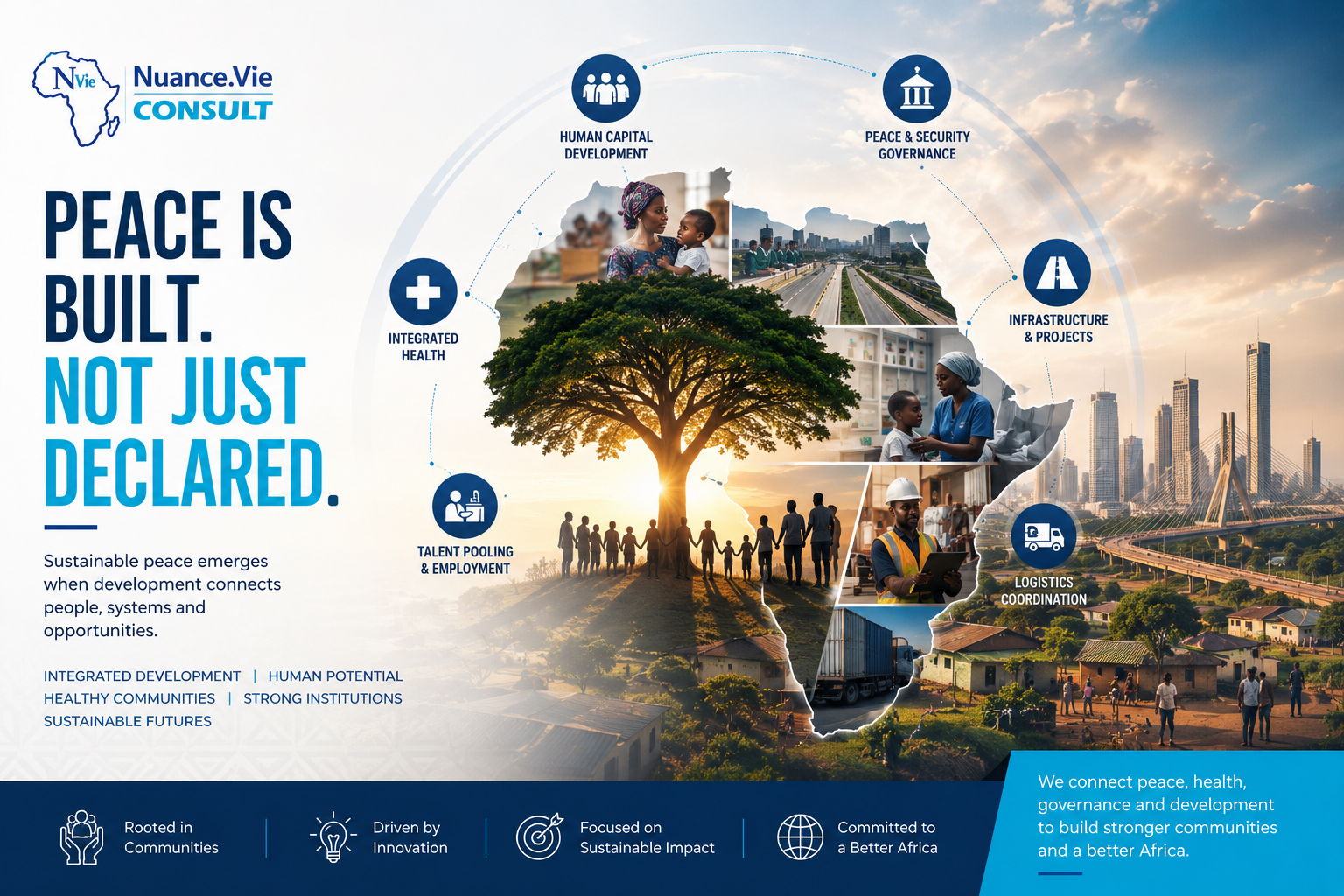
At Nuance Vie, this understanding sits at the center of how sustainable progress is approached — not as isolated interventions, but as integrated systems capable of supporting long-term human and structural development.
Peace Cannot Exist in Isolation
One of the most persistent weaknesses in development strategy is the tendency to treat insecurity as a stand-alone issue.
When communities experience instability, responses often prioritize immediate containment. While short-term security measures may sometimes be necessary, they rarely address the structural conditions that allowed tensions to grow in the first place.
In reality, insecurity often emerges from layers of unresolved social pressure:
weak governance systems,
economic exclusion,
poor infrastructure,
inadequate healthcare access,
unemployment,
institutional distrust,
and uneven development.
In several African contexts, these pressures accumulate gradually over years. By the time conflict becomes visible, the underlying systems may already have been under strain for a long period.
This is why development conversations that ignore governance, health systems, or human capital frequently struggle to produce lasting outcomes. Communities cannot sustain peace where institutions remain absent, opportunities remain inaccessible, and public trust continues to erode.
The African Development Conversation Is Changing
There is a growing recognition across the continent that imported development models do not always translate effectively into local realities.
Many communities operate within deeply layered social environments where informal leadership structures, cultural systems, economic survival networks, and historical experiences influence how people respond to policies and interventions.
A project that appears technically sound on paper may fail entirely if it does not account for these realities.
This is particularly visible in rural and underserved regions where development initiatives sometimes arrive with strong funding but weak community integration. Infrastructure is commissioned without long-term maintenance systems. Youth empowerment programs are launched without local economic absorption capacity. Healthcare interventions are introduced without sufficient trust-building or community ownership.
Over time, communities begin to associate development with temporary visibility rather than sustainable transformation.
That perception matters more than many institutions realize.
People support systems they believe will remain accountable to them long after external attention fades.
Why Integrated Development Matters
Integrated development recognizes a simple but powerful truth: communities function as interconnected systems.
Healthcare outcomes influence economic productivity. Governance affects investment confidence. Education shapes social mobility. Infrastructure affects access to healthcare, commerce, and public services. Human capital determines whether institutions can sustain progress independently.
When one area weakens significantly, the effects spread across the wider system.
This interconnected reality is especially important in fragile or rapidly growing regions across Africa, where population expansion, urban migration, climate pressures, and youth unemployment continue to reshape social dynamics at an accelerated pace.
A peacebuilding strategy that ignores employment realities among young populations may struggle to remain effective. Similarly, infrastructure projects that overlook community participation often face sustainability challenges after implementation.
Integrated development is not simply about doing many things at once. It is about understanding how different sectors reinforce or undermine one another.
That distinction is important.
Too often, organizations pursue fragmented interventions while assuming collective impact will emerge automatically. In practice, disconnected systems usually produce disconnected outcomes.
Community Trust Is Often the Missing Infrastructure
Physical infrastructure receives significant attention in development planning, but social infrastructure is frequently underestimated.
Trust, legitimacy, institutional credibility, and community participation are not abstract ideas. They are operational necessities.
Communities are far more likely to support initiatives when they believe:
local realities were understood,
their voices influenced decision-making,
implementation will remain accountable,
and outcomes will extend beyond political timelines.
This becomes particularly important in areas where previous interventions may have failed or where institutional trust has weakened over time.
In many African communities, local relationships still shape implementation success more than formal documentation alone. Development strategies that recognize this dynamic tend to achieve stronger long-term engagement because they work with existing social structures instead of bypassing them.
There is also a broader lesson here for policymakers and development actors.
Communities do not only evaluate what is delivered. They evaluate how it is delivered.
That distinction often determines whether progress becomes sustainable or temporary.
Human Capital Is a Peace and Development Strategy
Africa’s development future will depend heavily on how effectively institutions invest in people, not only projects.
The continent’s youthful population represents enormous potential, but demographic advantage alone guarantees nothing. Without systems capable of translating talent into opportunity, population growth can intensify existing pressures rather than relieve them.
This is why human resource development deserves greater attention within peace and governance discussions.
When young people remain excluded from meaningful economic participation, frustration can evolve into distrust toward institutions and governance structures. Conversely, communities with stronger access to education, professional pathways, leadership opportunities, and entrepreneurial ecosystems tend to develop greater long-term resilience.
Human capital is not separate from peacebuilding.
It is one of its foundations.
Organizations working within development spaces increasingly need to move beyond short-term program visibility and focus more intentionally on institutional continuity, local capacity building, and sustainable leadership pipelines.
Without that shift, many initiatives risk becoming dependent on external support rather than catalysts for self-sustaining progress.
Africa Does Not Need More Visibility Without Sustainability
There is no shortage of development conversations across Africa today. Conferences are organized. Reports are published. Pilot programs are launched regularly.
But sustainable impact requires more than visibility.
It requires implementation discipline, systems thinking, and long-term institutional commitment.
One of the more uncomfortable truths within the development sector is that some initiatives are designed more effectively for donor reporting than for durable community transformation. Metrics become easier to measure than real structural progress.
Communities, however, experience outcomes differently.
They measure success through continuity:
Are healthcare services still functioning?
Are infrastructure projects still usable?
Are young people finding opportunities?
Are local institutions becoming stronger?
Has public trust improved?
These are slower questions. More difficult questions. But they are ultimately the questions that determine whether peace and development become sustainable realities rather than temporary interventions.
A More Sustainable Path Forward
Africa’s development future will likely belong to institutions capable of thinking beyond isolated sectors.
The strongest long-term outcomes may emerge from organizations that understand the relationship between governance, health systems, infrastructure, logistics, human capital, and community participation as interconnected parts of the same ecosystem.
This approach requires patience. It also requires deeper local understanding, adaptive implementation models, and the willingness to prioritize sustainability over short-term visibility.
But the alternative — fragmented systems attempting to solve interconnected problems independently — has repeatedly shown its limitations.
Sustainable peace is not built only through policy declarations or emergency responses. It is built gradually through institutions, trust, opportunity, and systems that allow communities to participate meaningfully in their own development.
That work is slower than many headlines prefer.
But it is usually the work that lasts.
Why Sustainable Peace in Africa Requires Integrated Development.
Back to Blog